Essential Features of a Padel Tennis Court
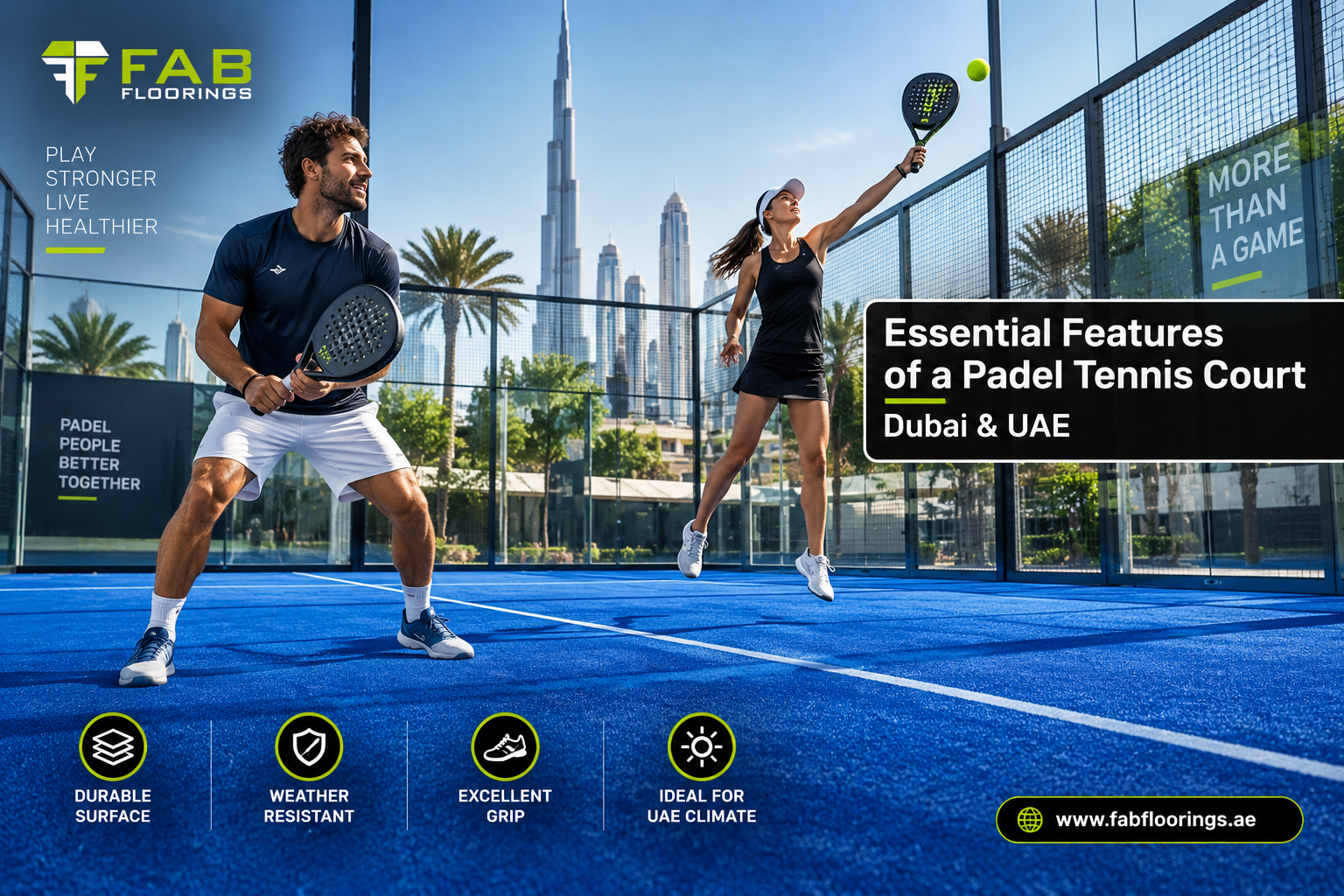
Padel has become a popular racquet sport across the UAE, with growing interest from sports clubs, hotels, residential communities, fitness facilities, and commercial developments. Building a successful padel facility requires more than installing a playing surface. Every element, from the court dimensions and enclosure to the turf, lighting, drainage, and foundation, can influence player safety and performance.
A professionally designed padel tennis court should combine accurate construction, durable materials, proper drainage, and weather-resistant components. This is especially important in Dubai and other UAE locations where high temperatures, strong sunlight, dust, and occasional rainfall can affect outdoor sports facilities.
What Makes a Padel Tennis Court Different?
Unlike traditional tennis courts, padel is played inside an enclosed court where the walls are part of the game. Players can use the glass and mesh walls to return the ball, making the quality and positioning of the enclosure essential.
A well-designed court should provide:
- Consistent playing conditions
- Reliable ball rebound
- Good player traction
- Adequate safety clearance
- Durable construction
- Proper drainage
- Effective lighting
- Resistance to UAE weather conditions
1. Standard Padel Court Dimensions
A standard padel court measures 20 metres long and 10 metres wide. The dimensions should be accurately maintained to provide the correct playing area and ensure consistency for training and competitive matches.
The net is positioned across the centre of the court, with the playing enclosure surrounding the court.
Accurate measurements are particularly important when planning commercial padel facilities, sports clubs, and tournament venues.
2. High-Quality Tempered Glass Walls
Glass is one of the defining elements of a padel court because the walls form part of gameplay.
Professional courts generally use toughened or tempered safety glass designed to withstand repeated ball impacts and demanding use. The glass should provide clear visibility while maintaining structural strength.
Important considerations include:
- Impact resistance
- Proper thickness and certification
- Secure fixing systems
- Accurate panel alignment
- Safe edges and connections
- Clear visibility for players and spectators
The glass system should be installed by experienced professionals to maintain both safety and playing performance.
3. Strong Metal Structure and Mesh Fencing
The glass panels are supported by a structural framework and mesh fencing. For outdoor courts in the UAE, the metal structure should be designed to handle heat, dust, humidity, and occasional rain.
Corrosion-resistant steel, suitable protective coatings, strong connections, and smooth edges can improve the durability of the enclosure.
A properly installed mesh system also helps keep the ball within the playing area while maintaining visibility.
4. Durable Padel Court Flooring
The playing surface has a direct effect on player movement, traction, comfort, and ball behaviour.
Artificial turf is commonly used for padel courts because it can provide a consistent playing surface when correctly specified and maintained. Turf selection should consider:
- Ball bounce
- Player grip
- Shock absorption
- Drainage
- UV exposure
- Playing frequency
- Maintenance requirements
For outdoor padel courts in Dubai, UV-resistant materials are particularly important because prolonged sunlight can affect the performance and appearance of unsuitable surfaces.
5. Proper Foundation and Base Preparation
A durable padel court starts below the playing surface. The foundation must provide a stable and level base for the structure and flooring system.
Depending on the project, the base may incorporate properly prepared soil, aggregate layers, concrete, or asphalt.
Poor base preparation can result in:
- Uneven surfaces
- Cracking
- Water accumulation
- Structural movement
- Premature surface deterioration
Professional site preparation helps create a stable foundation for the complete court system.
6. Effective Drainage for Outdoor Courts
Drainage is an important consideration for outdoor padel courts. Although the UAE has a relatively dry climate, sudden rainfall can create water accumulation if the court has not been designed correctly.
A suitable drainage system helps move water away from the playing surface and protects the underlying base.
Good drainage can also reduce maintenance requirements and help the court return to usable condition more quickly after rainfall.
7. Professional Padel Court Lighting
Many padel facilities operate during the evening, making lighting an important part of court design.
LED sports lighting can provide efficient illumination while reducing dark areas and excessive shadows. Light positioning should be carefully planned to minimize glare for players.
A professional lighting design should consider:
- Uniform illumination
- Glare control
- Light positioning
- Energy efficiency
- Maintenance access
- Intended recreational or competitive use
8. Reliable Net and Post System
The net divides the court and must be installed at the appropriate height and tension.
A quality net system should include durable, weather-resistant materials and stable posts. Proper installation prevents excessive movement and helps maintain consistent playing conditions.
The posts and surrounding components should also be positioned safely to avoid unnecessary hazards for players.
9. Player Safety Features
Safety should be considered throughout the entire court design rather than treated as an additional feature.
Important safety considerations include:
- Non-slip playing surfaces
- Secure glass panels
- Smooth structural edges
- Stable fencing
- Proper court access
- Suitable clearance around playing areas
- Correctly installed lighting
Using appropriate materials and professional installation can help create a safer environment for players and spectators.
10. Weather Resistance for UAE Conditions
Outdoor padel courts in the UAE need materials capable of handling demanding environmental conditions.
The court may be exposed to:
- High temperatures
- Strong UV radiation
- Dust and sand
- Humidity
- Occasional rainfall
UV-resistant turf, corrosion-resistant metalwork, durable glass fittings, and suitable protective coatings can help improve long-term performance.
11. Customization and Branding
Commercial padel facilities can also customize their courts to match their brand identity.
Possible options include:
- Club logos
- Sponsor branding
- Custom turf colours
- Court numbering
- Branded glass areas
- Customized structural finishes
Branding can make a facility more recognizable and create a consistent visual identity across multiple courts.
Why Professional Padel Court Installation Matters
A padel court is a complete sports system, not simply a combination of glass, steel, and artificial turf. Incorrect measurements, poor foundation preparation, weak connections, or improper turf installation can affect the playing experience and increase future maintenance requirements.
Professional installation helps ensure:
- Accurate court dimensions
- Proper structural alignment
- Secure glass installation
- Correct turf installation
- Effective drainage
- Reliable lighting placement
- Long-term structural stability
For commercial projects, selecting an experienced padel court manufacturer and installer in the UAE can make the construction process more efficient and reliable.
Conclusion
The essential features of a padel tennis court include accurate dimensions, strong tempered glass, corrosion-resistant structural components, quality artificial turf, a stable foundation, proper drainage, professional lighting, and appropriate safety measures.
For projects in Dubai and across the UAE, the court should also be designed with local heat, UV exposure, dust, and weather conditions in mind. Choosing suitable materials and professional installation can help create a durable court that delivers consistent performance and a better playing experience.