How Much Does It Cost to Build a Tennis Court?
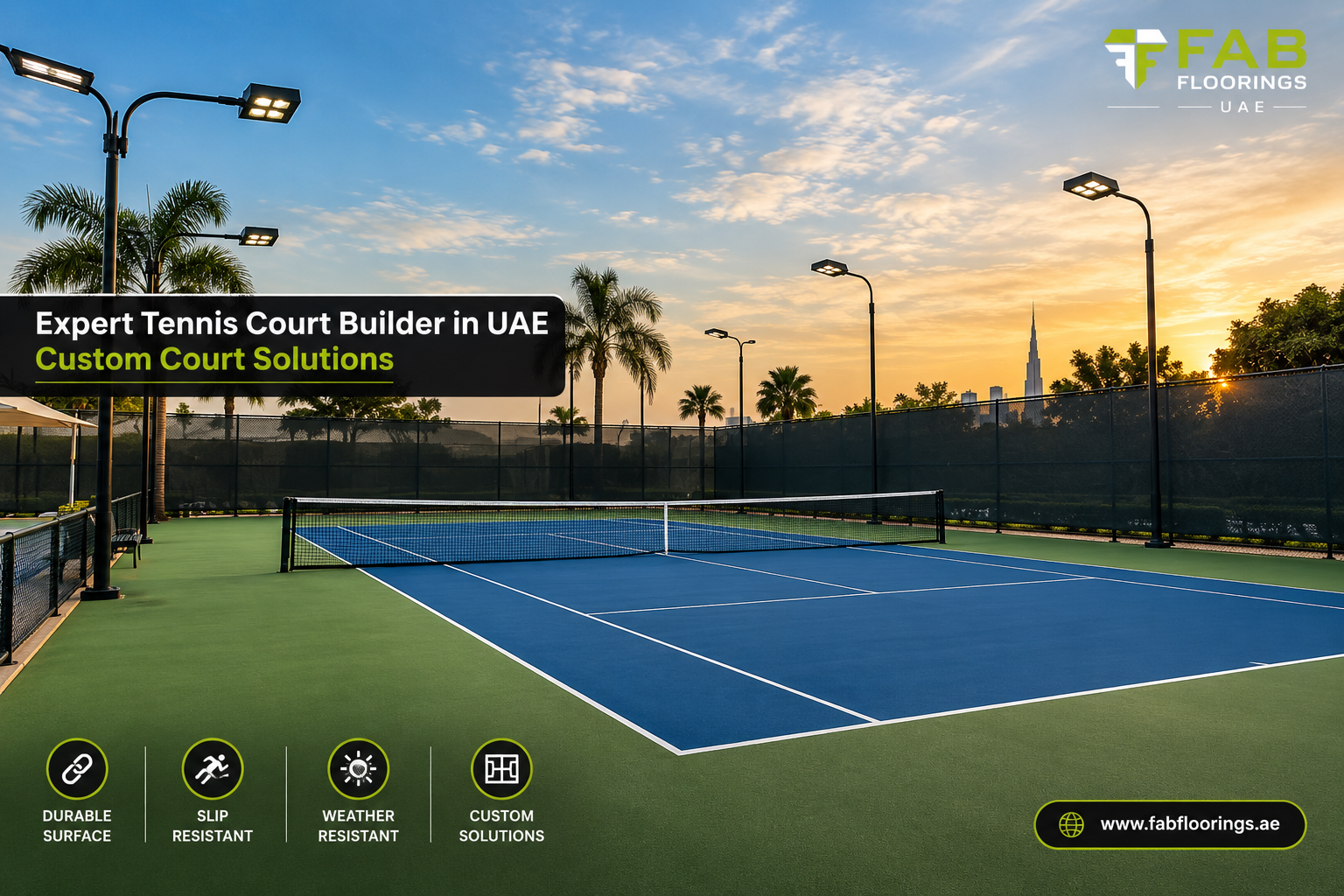
Building a tennis court is a significant investment, whether the project is for a private villa, residential community, hotel, school, sports academy, fitness club, or commercial sports facility.
The final cost is rarely determined by the playing surface alone. Site preparation, civil work, drainage, fencing, lighting, accessories, court size, surface system, and installation conditions can all affect the total project budget.
For projects in the UAE, a useful starting point for a standard outdoor tennis court is approximately AED 150,000 to AED 350,000+, but this should only be treated as an indicative range. A detailed quotation can vary significantly depending on the site and scope of work.
This guide explains the major cost factors so you can plan your tennis court project more accurately and compare contractor quotations effectively.
What Is Included in the Cost of a Tennis Court?
A complete tennis court project can involve much more than simply installing a coloured playing surface.
Depending on the project, the budget may include:
- Site preparation
- Excavation and levelling
- Sub-base and foundation
- Concrete or asphalt base
- Drainage
- Tennis court surface
- Cushioning system, if required
- Line marking
- Fencing
- Gates
- Net posts and tennis net
- Sports lighting
- Electrical work
- Landscaping or walkways
- Seating and player areas
- Transportation
- Installation and labour
The more complete the project scope, the higher the initial investment is likely to be.
How Much Does a Tennis Court Cost in the UAE?
For planning purposes, a standard outdoor tennis court in the UAE may fall around AED 150,000–AED 350,000+, depending on the site, surface, civil work, fencing, lighting, drainage, and accessories.
However, there is no single fixed price for every project.
For example, a project where a suitable existing base is already available may require considerably less civil work than a completely new court constructed on undeveloped or uneven land.
Similarly, a basic recreational court will have different requirements from a premium facility with professional lighting, spectator seating, landscaping, custom colours, branding, and upgraded accessories.
The best way to establish an accurate budget is to obtain a site-specific, itemised quotation.
What Factors Affect Tennis Court Construction Cost?
1. Site Condition and Preparation
The existing site is one of the biggest factors affecting construction cost.
Before installing a tennis court, the site may require:
- Excavation
- Clearing
- Levelling
- Soil preparation
- Compaction
- Stabilisation
- Sub-base construction
If the site is already level and has suitable ground conditions, preparation may be relatively straightforward.
If substantial civil work is required, the project budget can increase considerably.
The foundation is particularly important because an attractive surface cannot compensate for an unstable or poorly prepared base.
2. Tennis Court Surface
The playing surface is another major cost consideration.
Different surfaces provide different playing characteristics, maintenance requirements, and construction costs.
Acrylic Hard Court
Acrylic is a popular choice for outdoor tennis courts because it can provide a durable, consistent playing surface with relatively straightforward maintenance.
An acrylic system is generally installed over a properly prepared asphalt or concrete base with multiple surface layers. The ITF's court-construction guidance describes acrylic construction as a system built over a suitable base, with asphalt/concrete and acrylic surface layers.
PU Tennis Court Surface
Polyurethane systems can provide a resilient surface and may be considered where cushioning and player comfort are important.
The exact system and performance depend on the construction specification and manufacturer.
Synthetic Grass
Synthetic grass can provide a different playing feel and may be considered for recreational or specialised projects.
However, the construction and maintenance requirements differ from hard-court systems.
Clay
Clay courts offer distinctive playing characteristics but generally require more regular maintenance and water management.
For many UAE projects, the surface should be selected based on climate, usage, maintenance expectations, player requirements, and project budget, rather than price alone.
3. Base Construction
The playing surface sits on a properly prepared structural base.
Depending on the selected court system and site, construction may involve:
- Compacted foundation layers
- Aggregate
- Asphalt
- Reinforced concrete
- Levelling layers
- Surface coatings
The International Tennis Federation's court-construction guidance outlines foundation and base requirements for different court systems and stresses the importance of suitable construction beneath the playing surface.
A strong base is essential for maintaining surface quality and reducing problems such as cracking, settlement, or unevenness.
4. Drainage
Drainage is an important part of outdoor tennis court construction.
Even in the UAE, where rainfall is relatively limited, water management should not be ignored.
A suitable drainage strategy can help:
- Prevent standing water
- Protect the court surface
- Reduce water-related damage
- Improve drying time
- Support long-term performance
The cost of drainage depends on the site, existing drainage infrastructure, court construction, grading, and local conditions.
5. Tennis Court Fencing
Fencing is usually required around an outdoor tennis court to keep balls within the playing area and provide a defined boundary.
The final cost depends on:
- Fence height
- Fence length
- Mesh specification
- Posts
- Gates
- Coating
- Wind conditions
- Custom requirements
A typical tennis court project may use perimeter fencing in the 3–4 metre range, although the final specification should be determined according to the facility and project requirements.
Additional ball-stop netting can also be considered in selected areas.
6. Sports Lighting
If the court will be used after sunset, lighting becomes an important part of the project.
A tennis lighting system may include:
- LED sports floodlights
- Poles
- Electrical cabling
- Control systems
- Distribution equipment
- Installation
Professional sports lighting should provide suitable and reasonably uniform illumination across the playing area while limiting glare for players.
Adding lighting during the initial construction stage can be more practical than retrofitting the system later.
7. Court Accessories
A tennis court also requires playing equipment and supporting accessories.
These may include:
- Tennis net
- Net posts
- Centre strap
- Gates
- Player benches
- Ball-stop nets
- Scoreboards
- Shade structures
- Equipment storage
These items may represent a smaller portion of the overall construction budget, but they should still be included when comparing quotations.
8. Court Size and Surrounding Space
The official playing court itself has fixed dimensions.
According to the International Tennis Federation, a tennis court is:
- 23.77 m long
- 8.23 m wide for singles
- 10.97 m wide for doubles
The surrounding run-off space is additional and is important for safe player movement.
This means the land required for a tennis court is considerably larger than the playing rectangle itself.
When planning a new court, allow space for:
- Run-backs
- Side-runs
- Fencing
- Access gates
- Lighting poles
- Walkways
- Drainage
- Seating
- Landscaping
Not accounting for the surrounding space early in the design can create problems later.
9. Location and Accessibility
The project location can also influence the overall cost.
Factors may include:
- Distance from material suppliers
- Site accessibility
- Transportation
- Material handling
- Labour requirements
- Existing infrastructure
- Crane or equipment access
A difficult-to-access site may require additional logistical planning and equipment.
10. Custom Design and Premium Finishes
A basic court can be upgraded with additional design and architectural features.
Popular options include:
- Custom court colours
- Club branding
- Logos
- Premium fencing
- Spectator seating
- Landscaping
- Walkways
- Shade structures
- Player shelters
- Professional lighting
- Equipment storage
These additions can increase the initial investment but may significantly improve the appearance and usability of the facility.
How Much Does the Tennis Court Surface Cost?
It is difficult to provide a meaningful surface-only price without knowing the complete specification.
The cost depends on:
- Surface type
- Number of layers
- Cushioning requirements
- Base condition
- Court size
- Line-marking system
- Material quality
- Installation method
For this reason, comparing a quotation based only on the price per square metre can be misleading.
Two contractors may quote different prices because one includes the base, drainage, fencing, lighting, or preparation while the other does not.
New Court vs Existing Base
One of the most important questions to ask is:
Are you building a completely new court or converting an existing suitable surface?
New Construction
A new court may require:
- Site clearing
- Excavation
- Soil preparation
- Compaction
- Foundation
- Base construction
- Drainage
- Playing surface
- Fencing
- Lighting
- Accessories
This naturally requires a larger investment.
Existing Suitable Base
If a suitable existing base is already available, some civil-work costs may be reduced.
However, the existing surface must be professionally assessed before assuming that it can be reused.
How to Reduce Tennis Court Construction Costs
Reducing the budget does not necessarily mean choosing the cheapest materials.
Instead, focus on efficient project planning.
1. Start With a Site Assessment
Understand the ground conditions before finalising the budget.
2. Choose the Surface According to Usage
A private recreational court does not necessarily require the same specification as a professional training facility.
3. Plan Drainage Early
Trying to add drainage after construction can create unnecessary complications.
4. Combine Construction Work
Installing lighting, fencing, drainage, and other infrastructure during the initial project can be more efficient than adding them later.
5. Compare Itemised Quotations
Ask contractors to separate:
- Civil work
- Base construction
- Surface
- Fencing
- Lighting
- Drainage
- Equipment
- Installation
This makes it easier to compare quotations fairly.
What Should a Tennis Court Quotation Include?
Before approving a quotation, make sure you understand exactly what is included.
A detailed quotation should ideally specify:
Civil Work
- Excavation
- Levelling
- Compaction
- Base preparation
Court Construction
- Base system
- Surface system
- Cushioning, if applicable
- Line marking
Accessories
- Net
- Net posts
- Centre strap
- Gates
Fencing
- Fence height
- Mesh
- Posts
- Gates
Lighting
- Number of poles
- LED fixtures
- Electrical work
- Controls
Other Work
- Drainage
- Walkways
- Landscaping
- Transportation
- Installation
- Applicable taxes
An itemised quotation makes it much easier to understand why two tennis court contractors may offer very different prices.
Tennis Court Maintenance Costs
The initial construction budget is only one part of the overall investment.
Regular maintenance can help preserve the court's playing quality and appearance.
Maintenance may include:
- Routine cleaning
- Debris removal
- Surface inspection
- Crack repair
- Line maintenance
- Net inspection
- Fence inspection
- Drainage checks
- Lighting maintenance
- Periodic resurfacing
The required maintenance depends on the surface system, usage, weather exposure, and quality of installation.
How Long Does a Tennis Court Last?
There is no single lifespan that applies to every tennis court.
Longevity depends on:
- Construction quality
- Base preparation
- Surface system
- Usage
- Weather exposure
- Drainage
- Maintenance
- Repair history
A professionally designed and maintained court can provide long-term service, while poor drainage, inadequate base preparation, or neglected maintenance can shorten the useful life of the surface.
Is Building a Tennis Court Worth the Investment?
For the right property or facility, a tennis court can provide significant long-term value.
It can enhance:
- Residential communities
- Hotels and resorts
- Sports clubs
- Schools
- Universities
- Sports academies
- Private villas
- Fitness facilities
Beyond the financial aspect, a well-designed tennis court creates a dedicated space for exercise, training, recreation, and community activities.
Why Choose Fab Floorings for Tennis Court Construction?
A tennis court is a complete construction project rather than simply a flooring installation.
Fab Floorings can help plan tennis court flooring and related requirements based on the project's intended use, site conditions, surface preference, and performance expectations.
A professional tennis court project should consider:
- Court dimensions
- Surface selection
- Base preparation
- Drainage
- Fencing
- Lighting
- Line marking
- Accessories
- Maintenance requirements
The goal is to create a court that is safe, durable, visually appealing, and suitable for its intended level of play.
Final Thoughts
So, how much does it cost to build a tennis court?
For a standard outdoor tennis court in the UAE, a broad planning range of around AED 150,000 to AED 350,000+ can be used as an initial reference, but the final cost depends heavily on site conditions, surface type, civil work, fencing, drainage, lighting, accessories, and custom features.
The most important step is not simply finding the lowest quotation. It is understanding what each quotation includes and whether the proposed construction is suitable for the site and intended use.
A professionally planned tennis court with the right base, surface, drainage, fencing, and accessories can provide a much better long-term investment than a low-cost installation that requires frequent repairs.
If you're planning a tennis court in Dubai or anywhere across the UAE, Fab Floorings can help you evaluate your requirements and develop a suitable court solution.
Planning to build a tennis court? Contact Fab Floorings for a site assessment and customised quotation.