Why Some Flooring Materials Fail Faster in Dubai’s Climate – Explained
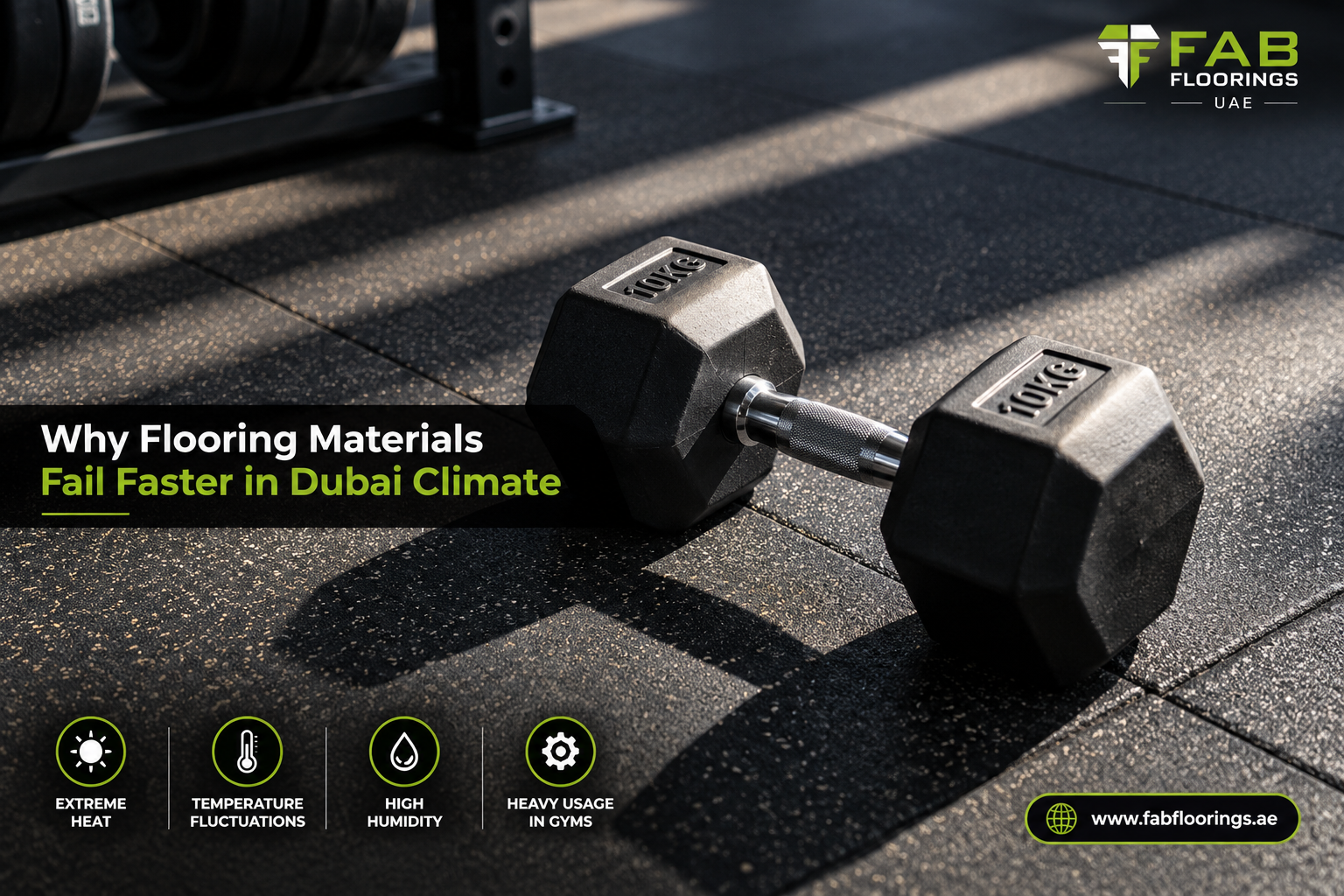
Dubai's climate can be demanding on flooring. High summer temperatures, strong sunlight, humidity, dust, frequent air conditioning, and heavy commercial use can all influence how flooring performs over time.
A flooring material that works well in a mild climate may not deliver the same lifespan when exposed to Dubai's environmental conditions. This is why selecting flooring based only on appearance or initial price can result in premature repairs and replacement.
Understanding how climate affects different flooring materials can help homeowners, gym owners, offices, hotels, retail spaces, and commercial facilities make better flooring decisions.
What Makes Dubai’s Climate Challenging for Flooring?
Several environmental factors can place additional stress on flooring materials.
Extreme Heat
Dubai experiences very high temperatures during summer. Flooring installed near windows, entrances, balconies, or partially exposed areas may experience significant heat and direct solar exposure.
Some materials can expand, soften, warp, fade, or lose their dimensional stability when exposed to excessive heat.
Temperature Changes
Indoor spaces are heavily air-conditioned while outdoor areas can be extremely hot. Moving between these conditions creates repeated temperature changes.
Some flooring materials respond to these changes through expansion and contraction. If the material or installation system cannot accommodate this movement, problems may develop over time.
Humidity and Moisture
Humidity can affect flooring, adhesives, and subfloors. Materials that are sensitive to moisture may experience swelling, lifting, adhesive problems, or surface deterioration.
This is particularly important in areas such as gyms, bathrooms, pool surroundings, kitchens, and other spaces where moisture is common.
Dust and Sand
Fine dust and sand can act as abrasive particles under footwear and equipment. In high-traffic commercial spaces, this can gradually contribute to surface wear and loss of finish.
Regular cleaning and suitable flooring specifications can help reduce the impact.
Which Flooring Materials Can Fail Faster?
Not every flooring material performs the same way in Dubai. The quality, construction, installation method, and location also make a significant difference.
Low-Quality PVC Flooring
Poor-quality PVC may be more vulnerable to excessive heat, heavy traffic, and prolonged use. Possible problems include deformation, fading, surface wear, or loss of stability.
Premium PVC products with appropriate wear layers can offer better performance when correctly specified and installed.
Low-Density Foam Flooring
Foam flooring can be useful for specific applications, but low-density products may compress more quickly under heavy equipment or continuous traffic.
They should therefore be selected according to the intended activity rather than simply choosing the cheapest option.
Untreated Wood Flooring
Natural wood responds to changes in temperature and humidity. Without suitable treatment, installation, and maintenance, it can experience expansion, contraction, swelling, or surface damage.
Low-Quality Laminate
Cheap laminate products may have limited resistance to moisture, impact, and heavy commercial traffic. Water penetration around joints can also become a concern if the product is not suitable for the environment.
Poor-Quality Rubber Flooring
Rubber flooring is generally a strong option for demanding applications, but not all rubber products have the same quality.
The rubber composition, density, manufacturing quality, thickness, and intended application should all be considered when selecting rubber flooring in Dubai.
What Flooring Works Well in Dubai?
The best flooring depends on where it will be installed and how the space will be used.
Rubber flooring: Suitable for gyms, fitness areas, sports facilities, and areas requiring impact resistance and durability.
EPDM flooring: Useful for selected outdoor and recreational applications where weather and UV resistance are important.
Premium PVC flooring: Can work well in commercial interiors when the product has suitable wear resistance and is correctly installed.
SPC flooring: Its rigid construction and water-resistant characteristics can make it suitable for various interior applications.
The important point is that there is no single flooring product that is ideal for every location. Performance requirements should come first.
Why Installation Matters
Even a high-quality flooring product can experience problems if the installation is poor.
Before installation, the subfloor should be properly prepared, clean, dry, stable, and level. Depending on the flooring system, installers may also need to consider adhesive compatibility, expansion requirements, joints, room conditions, and manufacturer specifications.
Poor installation can lead to:
- Loose flooring
- Raised edges
- Gaps
- Bubbling
- Uneven surfaces
- Adhesive failure
- Premature wear
How to Choose Durable Flooring for Dubai
Before purchasing flooring, consider these factors:
1. Check the Intended Application
A gym floor, office floor, outdoor walkway, playground, and retail floor have different performance requirements.
2. Consider Heat and UV Exposure
For areas exposed to sunlight or high temperatures, check whether the flooring is suitable for those conditions.
3. Consider Moisture
Choose moisture-resistant flooring for areas where humidity, water, or frequent cleaning is expected.
4. Check Traffic and Load
Heavy commercial traffic and gym equipment require flooring with appropriate durability and resistance to compression and impact.
5. Don't Choose Only by Price
A cheaper product may have a lower initial cost but require earlier repair or replacement. Compare quality, expected service life, installation requirements, and maintenance before making a decision.
Final Takeaway
Flooring failure in Dubai is not caused by heat alone. Temperature changes, humidity, sunlight, dust, heavy traffic, moisture, product quality, and installation practices can all influence flooring performance.
Choosing a flooring material that matches the Dubai climate and the specific application can help reduce premature wear and maintenance problems.
For commercial and high-traffic spaces, investing in properly specified, durable flooring can provide better long-term value than choosing a product solely because it has a lower upfront price.