Best Gym Flooring UAE: A Practical Guide for Commercial Fitness Spaces
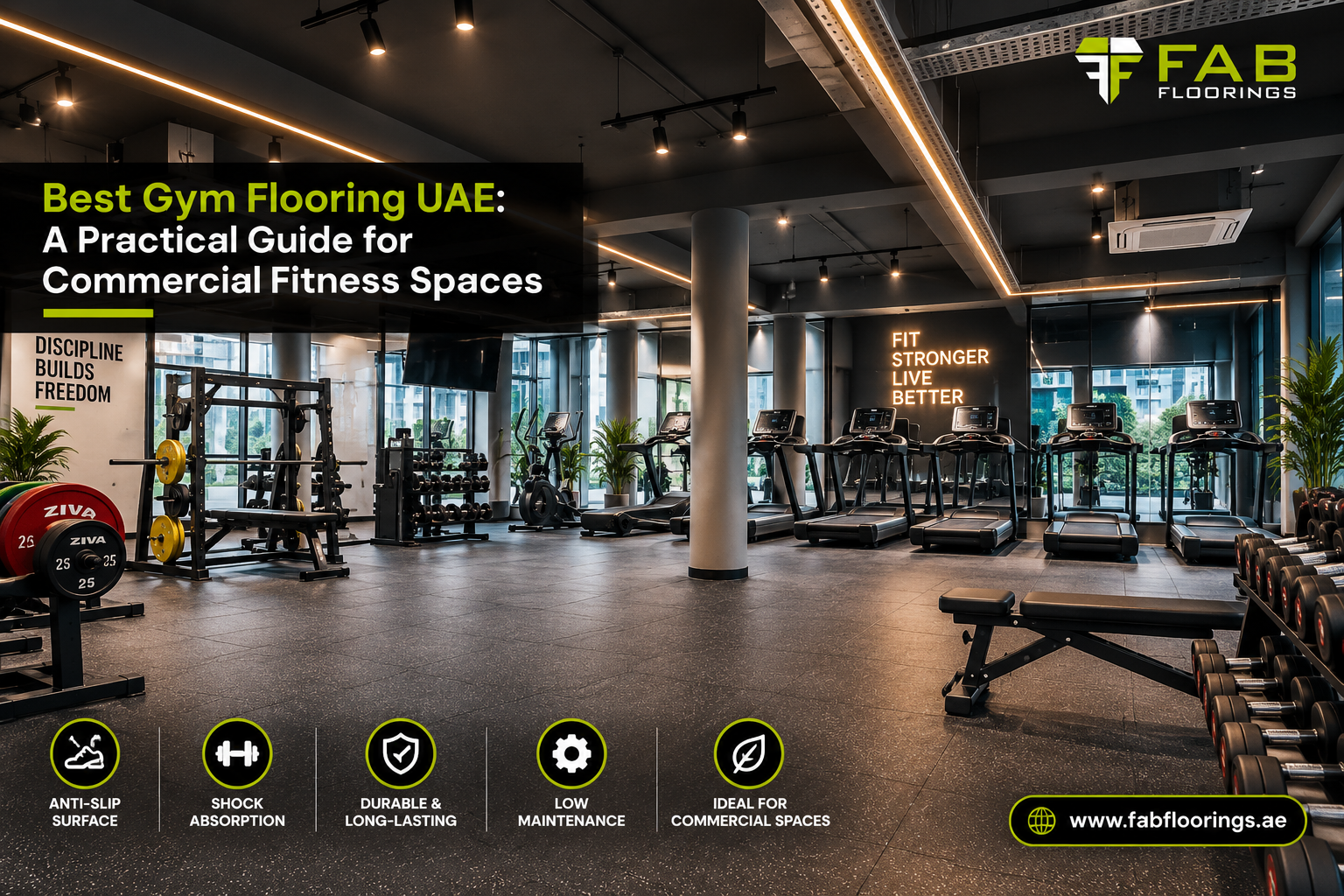
Choosing flooring for a commercial gym is more than selecting an attractive surface. The right gym flooring in UAE needs to handle heavy equipment, repeated impact, high foot traffic, sweat, cleaning, and demanding workouts while providing a safe and comfortable surface for users.
For commercial fitness centers, CrossFit boxes, weightlifting areas, personal training studios, and multi-purpose gyms, flooring should be selected according to the activity performed in each zone.
Why Is Gym Flooring Important?
A gym floor has to withstand considerably more stress than a standard commercial floor. Dumbbells can be dropped, machines remain in the same position for long periods, and hundreds of people may walk across the surface every day.
A suitable flooring system can help with:
- Impact and shock absorption
- Slip resistance and traction
- Protection of the subfloor
- Noise and vibration reduction
- Equipment stability
- Easier cleaning and maintenance
- Long-term durability
The flooring also contributes to the overall appearance and professional feel of a fitness facility.
Best Types of Gym Flooring in UAE
There is no single flooring product that is ideal for every gym area. Commercial facilities often combine different flooring solutions according to their activities.
1. Rubber Gym Flooring
Rubber flooring is one of the most practical choices for commercial fitness environments. It is commonly available as rubber tiles, interlocking tiles, and rubber rolls.
Its key advantages include durability, impact resistance, traction, and relatively straightforward maintenance.
Best for:
- Weightlifting areas
- Commercial gyms
- Functional training zones
- CrossFit facilities
- Strength-training areas
- Equipment zones
Rubber rolls are particularly useful for larger spaces because they can create a more continuous surface with fewer joints.
2. Rubber Tiles and Interlocking Flooring
Rubber tiles provide flexibility when designing different gym zones. Damaged sections can generally be replaced individually rather than removing an entire floor.
Interlocking systems can also simplify installation where adhesive-free or modular installation is appropriate.
Best for:
- Weight rooms
- Home and commercial gyms
- Functional training areas
- Equipment areas
- Renovation projects
3. EPDM Gym Flooring
EPDM flooring can provide a combination of durability, resilience, and design flexibility. EPDM surfaces are available in different colors and configurations, making them useful where appearance is an important part of the gym design.
They can be considered for selected indoor or outdoor fitness applications depending on the product specification and installation environment.
4. EVA Foam Mats
EVA mats are softer and lighter than heavy-duty rubber flooring. They are more suitable for activities where cushioning and comfort are more important than resistance to heavy weights.
Best for:
- Yoga areas
- Stretching zones
- Kids' fitness spaces
- Martial arts
- Light exercise areas
For heavy free weights, however, commercial-grade rubber flooring is generally a more appropriate choice.
5. PVC and Sports Flooring
PVC or specialist sports flooring can be considered for studios and multi-purpose fitness spaces where a smooth, easy-to-maintain surface is required.
The right specification depends on the activity, footwear, movement requirements, and expected traffic.
How to Choose Gym Flooring for Different Areas
A commercial gym should not necessarily use the same flooring throughout the facility.
| Gym Area | Suitable Flooring Approach |
|---|---|
| Cardio Area | Rubber rolls or suitable resilient flooring |
| Weightlifting Area | Heavy-duty rubber tiles or thick rubber flooring |
| CrossFit Area | Impact-resistant rubber + specialist zones |
| Functional Training | Rubber flooring or hybrid flooring |
| Yoga & Stretching | EVA or suitable cushioned flooring |
| Martial Arts | EVA or specialist sports mats |
| Machine Area | Dense rubber flooring |
| Sled Track | Rubber flooring with dedicated turf where required |
This zoning approach can provide better performance while avoiding unnecessary flooring costs.
What Gym Flooring Thickness Do You Need?
Thickness should be selected according to the type and intensity of exercise rather than choosing the thickest available product.
6–8 mm
Suitable for lighter-use areas such as:
- Cardio equipment
- General fitness
- Low-impact training
- Areas with limited weight dropping
10–15 mm
A practical range for many commercial gym areas where there is regular foot traffic, equipment, and moderate free-weight use.
20 mm or More
Thicker flooring can be appropriate for high-impact areas where heavy weights are regularly dropped or where additional protection is required.
The final specification should consider the flooring density, subfloor, equipment, impact level, and manufacturer's recommendations—not thickness alone.
Rubber Rolls vs Rubber Tiles: Which Is Better?
Both options can work well in commercial gyms, but their advantages differ.
Rubber rolls are useful for large areas because they provide fewer seams and a relatively uniform appearance.
Rubber tiles provide modular installation and make it easier to replace individual damaged sections.
For a large commercial gym, rolls may be practical for general floor coverage, while tiles can be useful in heavy-use or specialized zones.
What Should You Consider Before Buying Gym Flooring in UAE?
Before selecting a product, evaluate:
1. Workout Type
Determine whether the facility will focus on cardio, strength training, CrossFit, functional fitness, martial arts, or mixed activities.
2. Equipment Weight
Heavy machines and free weights require flooring with appropriate density and impact resistance.
3. Floor Traffic
A commercial fitness center with hundreds of daily users needs a more durable solution than a small private training studio.
4. Subfloor Condition
The existing floor should be clean, dry, stable, and sufficiently level before installation.
5. Maintenance
Choose a flooring system that can be cleaned efficiently according to the manufacturer's maintenance instructions.
6. UAE Climate
For areas exposed to heat, sunlight, humidity, or semi-outdoor conditions, check the product's environmental and UV-resistance specifications before installation.
How to Maintain Commercial Gym Flooring
Regular maintenance can help extend the useful life of gym flooring.
- Remove dust and debris regularly.
- Clean sweat and spills promptly.
- Use cleaning products recommended for the flooring.
- Avoid excessive water during cleaning.
- Inspect high-impact areas regularly.
- Check edges and joints for movement or damage.
- Replace severely damaged sections when necessary.
Good maintenance is particularly important in commercial gyms because heavy traffic can accelerate normal wear.
Why Professional Installation Matters
Even high-quality flooring can perform poorly if the installation is incorrect.
The installation team should assess the subfloor, measure the area accurately, plan seams and joints, and follow the flooring manufacturer's requirements. Proper installation can also help reduce movement, unevenness, and premature deterioration.
For large commercial projects, it is useful to discuss the flooring requirements with the supplier before purchasing so the product, thickness, and installation method match the intended application.
How Much Does Gym Flooring Cost in UAE?
The cost of gym flooring depends on several factors, including:
- Flooring type
- Thickness and density
- Total floor area
- Tiles vs rolls
- Design and color
- Subfloor preparation
- Installation requirements
- Project location
Instead of choosing purely on the lowest price per square meter, commercial gym owners should consider durability, maintenance, replacement costs, and expected service life.
Final Takeaway
The best gym flooring in UAE depends on how the space will actually be used. Heavy weightlifting areas need stronger impact protection, while cardio, studio, yoga, and functional-training areas may require different flooring characteristics.
For most commercial fitness facilities, a properly specified rubber flooring system is a practical starting point because of its durability, traction, impact resistance, and versatility.
The best approach is to divide the gym into activity zones and select the flooring specification according to the equipment, workout intensity, traffic, subfloor, and environmental conditions.