Rubber vs Vinyl Flooring: Which Is Better for Gyms?
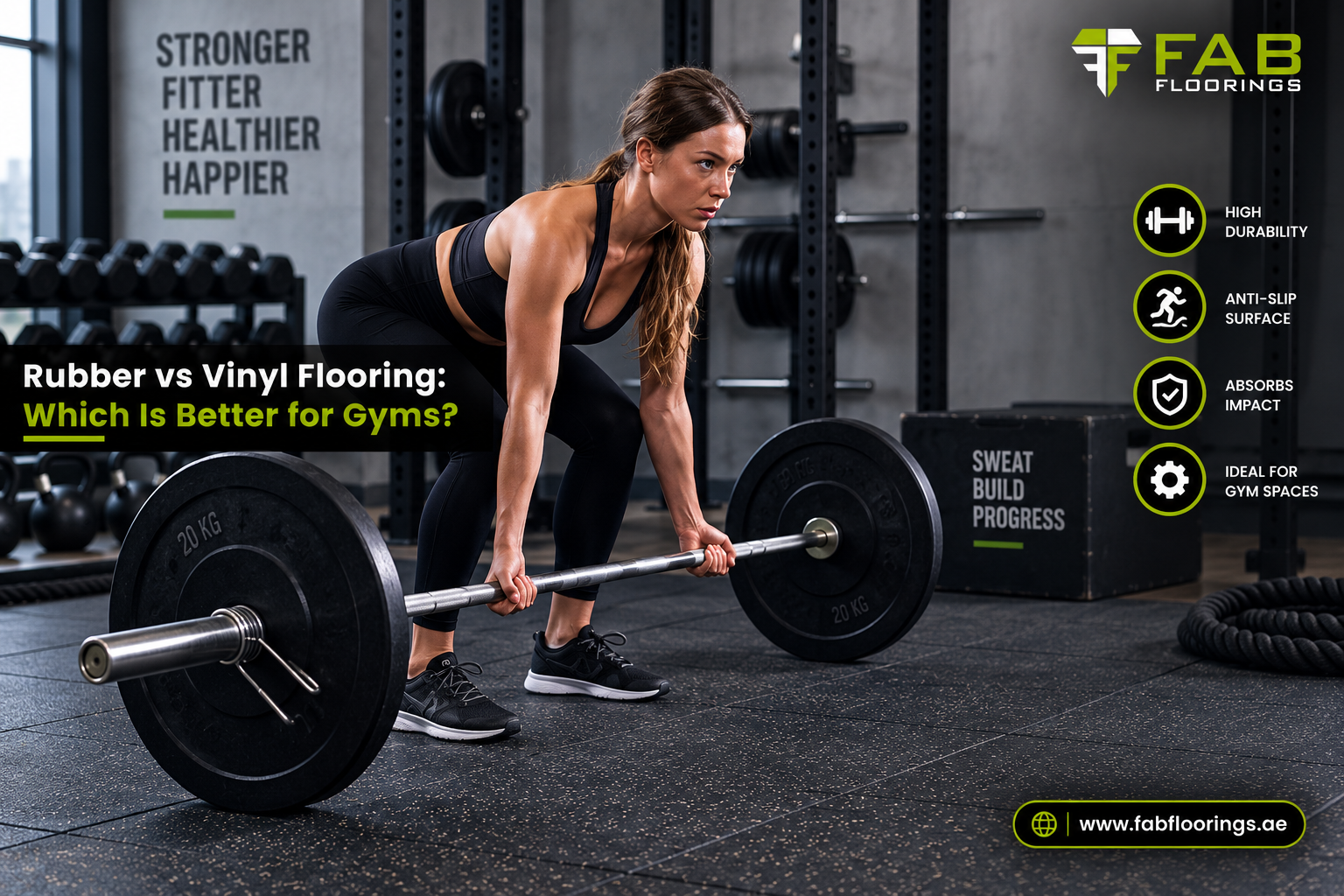
Choosing the right flooring can directly affect the safety, comfort, maintenance, and long-term performance of a gym. Rubber and vinyl flooring are both popular options, but they are designed to perform differently.
Rubber is generally better for heavy-impact activities, free weights, and strength training, while vinyl can be a practical choice for studios, cardio areas, and spaces where easy cleaning and visual design are priorities. The best solution depends on how each area of the gym will be used.
Rubber Flooring for Gyms
Rubber flooring is designed to handle demanding environments. It is available in tiles, interlocking tiles, rolls, and mats, with different thicknesses for different applications.
Its resilient surface helps absorb impact from exercise and equipment, making it particularly useful in weight-training and functional fitness areas.
Key Benefits of Rubber Gym Flooring
- Excellent impact resistance
- Suitable for heavy gym equipment
- Good slip resistance
- Helps reduce noise and vibration
- Comfortable for prolonged standing and workouts
- Durable under heavy foot traffic
- Available in different thicknesses and formats
- Easy to maintain with appropriate cleaning methods
Rubber flooring is especially suitable for weightlifting areas, CrossFit zones, functional training spaces, and commercial gyms where the floor experiences repeated impact.
Vinyl Flooring for Gyms
Vinyl flooring is a PVC-based flooring option available in different colours, patterns, textures, tiles, and rolls. Its smooth finish and design flexibility make it attractive for fitness spaces where appearance and easy cleaning are important.
Vinyl can work well in areas with moderate activity and controlled equipment loads.
Key Benefits of Vinyl Gym Flooring
- Wide range of colours and designs
- Smooth and easy-to-clean surface
- Good resistance to moisture
- Suitable for moderate foot traffic
- Can create a modern, professional appearance
- Generally offers a lower initial flooring cost
- Suitable for studios and multipurpose fitness areas
Vinyl is often considered for yoga studios, Pilates rooms, group exercise areas, cardio zones, and multipurpose spaces where heavy weight drops are not expected.
Rubber vs Vinyl Flooring: Direct Comparison
| Feature | Rubber Flooring | Vinyl Flooring |
|---|---|---|
| Impact resistance | Excellent | Moderate |
| Heavy weight training | Excellent | Limited |
| Shock absorption | High | Moderate |
| Slip resistance | Generally high | Depends on product |
| Noise reduction | Very good | Limited |
| Design options | Good | Excellent |
| Cleaning | Easy | Very easy |
| Heavy equipment | Highly suitable | Application dependent |
| Initial cost | Usually higher | Usually lower |
| Best use | Strength & high-impact areas | Studios & moderate-use areas |
The exact performance depends on the product specification, thickness, installation method, subfloor, and intended use.
Which Is Better for Heavy Weightlifting?
Rubber flooring is the better choice.
Free weights can create concentrated impact when dumbbells, kettlebells, or barbells are dropped. Rubber's resilient structure makes it better suited to absorbing impact and protecting the subfloor.
For dedicated lifting areas, gym owners should select a flooring thickness and density appropriate for the equipment and workout intensity rather than choosing based on price alone.
Which Is Better for Cardio Areas?
Both can work, but the choice depends on the equipment and overall design.
Rubber provides a resilient, durable surface for treadmills, functional training, and high-traffic cardio areas. Vinyl can be suitable where equipment loads and impact are moderate and a smooth decorative finish is preferred.
Which Is Better for Yoga and Group Fitness?
Vinyl can be a practical choice for yoga, Pilates, stretching, and group fitness spaces where heavy equipment and dropped weights are not involved.
Rubber can also work well when additional grip, resilience, and impact protection are priorities.
Which Flooring Is Easier to Maintain?
Both materials are relatively easy to maintain when the correct cleaning products and procedures are used.
Vinyl has a smooth surface that can make routine mopping straightforward. Rubber is also easy to maintain, but cleaning products should be compatible with the particular rubber flooring to avoid affecting its surface.
Regular removal of sweat, dust, and dirt is important for both flooring types.
Rubber vs Vinyl: What About Cost?
Vinyl generally has a lower initial material cost, while rubber can require a larger upfront investment.
However, the cheapest flooring is not necessarily the most economical choice. A flooring system should be evaluated according to expected traffic, equipment loads, replacement requirements, maintenance, and intended lifespan.
For a commercial gym with heavy strength training, investing in suitable rubber flooring can make more sense than installing a less suitable material and replacing it prematurely.
Can a Gym Use Both Rubber and Vinyl Flooring?
Yes. In many cases, using both is the most practical solution.
A gym does not have to use one flooring material throughout the entire facility.
For example:
- Free-weight zone: Heavy-duty rubber
- Functional training: Rubber flooring
- Cardio area: Rubber or suitable commercial vinyl
- Yoga/Pilates studio: Vinyl or appropriate resilient flooring
- Reception: Decorative vinyl
- Group exercise room: Vinyl or rubber depending on activity
This zone-based approach allows gym owners to select flooring according to actual performance requirements.
Rubber vs Vinyl Flooring for Dubai Gyms
For gyms in Dubai and the UAE, flooring should also be selected with the local environment and indoor operating conditions in mind.
Commercial gyms experience heavy foot traffic, continuous air conditioning, regular cleaning, and frequent exposure to sweat and moisture. The flooring system should therefore be properly specified and professionally installed.
For high-impact fitness areas, rubber gym flooring in Dubai is generally the stronger choice because of its resilience and ability to handle demanding use.
Final Verdict: Rubber or Vinyl?
There is no single flooring material that is best for every gym area.
Choose rubber flooring if you need:
- Heavy-impact protection
- Weightlifting performance
- Better vibration and noise control
- High durability
- Flooring for CrossFit or functional training
Choose vinyl flooring if you need:
- A decorative finish
- Easy routine cleaning
- Moderate-use flooring
- A cost-conscious solution
- Flooring for studios or multipurpose areas
For a full commercial gym, combining rubber and vinyl according to different zones can provide the best balance of performance, appearance, and cost.